For nursing and health science students
How do you know you're ready?
See where you are solid, where you are guessing, and what to study next. Personalized, adaptive quizzes, built from your professor's material.
A patient with AKI has a serum potassium of 6.8 mEq/L. Which intervention should be prioritized?
First: how confident are you that you know the answer?
Rating first is deliberate — it makes you retrieve the answer before the options can do it for you.
How it works
Rate how sure you are. Answer. Find out which one was true.
Answering a question is not the test at the end. It is the studying. Decades of research put retrieval ahead of rereading, and this whole product is built on that one finding.
Every question comes from your professor's material and is approved by them. What changes is which questions you get. The set adapts to your progress, so two students in the same course are not working through the same list, and your confidence and your accuracy are tracked side by side so you can see where the two come apart.
01
Say how sure you are
Before you answer, you rate your confidence. Be honest. It never affects your grade.
02
Answer, then dig deeper
The explanation appears as soon as you answer. Dig Deeper adds why your choice was wrong.
03
Clear what you missed
Questions you get wrong, and new ones on your weak topics, come back shuffled until you get them right.
Features
Grounded in your professor's material. Generated by a patent-pending engine.
One source of truth: every question traces back to the course material it came from. Students study with it; educators build with it.
01
Sure and wrong is the fastest thing to fix
The confidence check
Every question asks how sure you are before it shows you the answer. Being sure and wrong matters more than a topic you already know is shaky, and only one of those two feels like a problem while you study.
02
Reading it again is not studying
Dig Deeper
Open any question for the full reasoning: why the right answer is right, why yours was wrong, and the misconception underneath it. It arrives in seconds, not after you have gone back to the chapter.
The same digging follows you around. Flashcards carry their own chips for why it is right, why not the others, and the key takeaway. Anywhere else, highlight a phrase and ask, or open the tutor beside what you are reading without losing your place. Quizzes can also be set to teach as they test, with hints you can open before you commit.
03
A tutor that quizzes you, not one that answers for you
LeetLearn
Ask it to explain something, or say quiz me on my weakest topics and it builds one. Every answer cites the passage in your own course material that it came from, so you can open the source and check it.
A tutor that simply hands over answers makes practice feel good and leaves you worse off on the day. That is why this one is built to question you back.
04
Built because students told us they study in the car
Listen instead of read
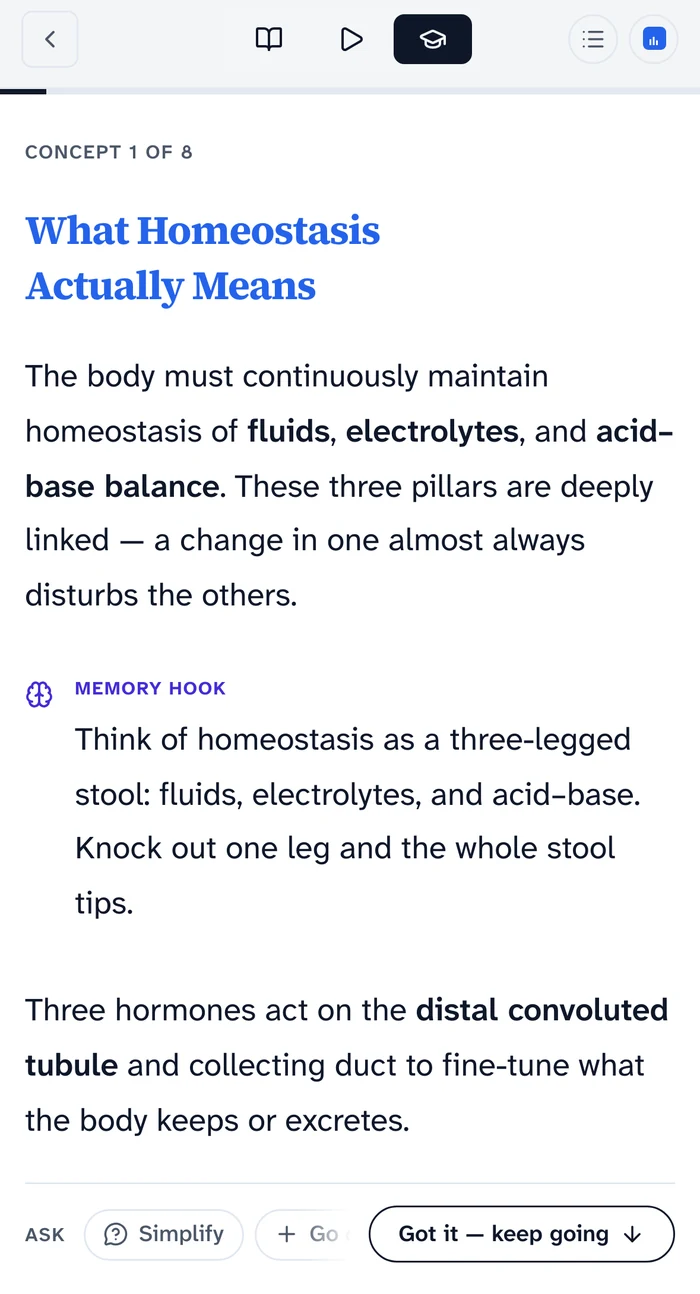
Every concept review opens three ways, and all of them fit a phone. Read it straight through, present it one concept at a time, or work through it in Learn mode. Tap Listen and it is read aloud with the words highlighted as they are spoken, so the commute and the walk between buildings become study time.
05
Spaced recall, with nothing to set up
Missed questions come back
Questions you get wrong come back later with the answers shuffled, so you recall the answer instead of recognising its spot. Get one right and that question is gone for good. Miss it again and it returns to the back of the line. Where a topic is weak or overconfident, fresh questions on it join the queue too.
06
Mixing topics beats drilling one at a time
Build your own practice
Pick the topics you want and Leeteracy Clinic builds one set that moves between them. Mixing is the hard part and the point: you have to work out which situation you are in before you can decide what to do, which is exactly what an exam question asks of you.
Quizzes are one of three formats. The same picker builds a flashcard deck you grade yourself on, or a concept review you can read, watch or listen to. Reviews carry memory hooksfor the lists you have to know cold, and LeetLearn answers questions inside the review. Build any of it from your instructor's readings or your own notes, and it stays private to you.
On a flashcard you can say your answer out loud. Leeteracy tells you whether you were right, then flips the card.
07
The exam stopped asking what you memorized
Built for clinical judgment
In 2023 the NCLEX added item types designed to measure clinical judgment rather than recall, built on the licensing board's own model of how a nurse thinks through a case. Leeteracy Clinic writes those formats from your course material: Cloze, Matrix and Bow Tie.
When you get one wrong you are not just told the answer. You are shown which part of the thinking came apart, whether that was noticing the cue, working out what mattered most, or choosing the action.
08
Patent pending
How every question is made
A question that is wrong is worse than no question at all, so nothing reaches you on a single pass. Each one is written from a retrieved passage in your own course material, aimed at a difficulty level, then put through four checks before it is saved.
Anything that fails a check is regenerated, not patched and not shown to you.
Before and after
Four hours of reading, and you still find out on exam day.
There is a version of studying where you learn what you do not know while it still matters.
A normal study night
- Reread the chapter
- Highlight the parts that felt important
- Feel ready
- Find out on exam day
A night in Leeteracy Clinic
- Answer twenty questions on the topic
- Rate how sure you are on each one
- See the four you were sure about and wrong on
- Study those four
Questions
What students ask first.
Does my confidence rating affect my grade?
No. Confidence ratings are never part of a score. They exist so you can see where your sense of what you know and your actual accuracy come apart. Rating honestly is the only way the feature is worth anything to you.
How do I join my course?
Your instructor gives you a join code or a QR code to scan, or sends an email invite. Create an account, enter the code, and the course appears in your list. If you are in more than one, they are grouped into the courses you were invited to and the study spaces you set up yourself.
Where do the questions come from?
Your instructor's own materials. Questions are generated from the readings and slides your course uses, and every question traces back to the passage it came from. Your instructor approves each one before you see it.
Which of those questions you get is personal. The set adapts to how you have been doing, and when your accuracy on a topic drops the next set steps down a level of thinking, recall before application, so you rebuild the ground rather than repeating what you just missed.
Getting there takes more than asking a model for a question. Every one runs a patent pending pipeline that retrieves the source passage, writes to a target difficulty, then checks the result structurally, has a second model check it against a rubric, and rejects it if it duplicates something already in your course. Anything that fails is regenerated rather than shown to you.
Are the questions like the ones on the NCLEX?
They target the same kind of thinking: interpreting cues, prioritizing, and multi step reasoning rather than pure recall. Formats include the newer NGN style items such as Cloze, Matrix and Bow Tie.
Is this only for nursing?
No. Leeteracy builds questions from whatever material a course uses, and an instructor sets the cognitive model it measures against, so the same engine works outside healthcare. Nursing and healthcare board prep is where we started and where the product is deepest today.
Can my instructor see everything I do?
Your instructor sees your scores on assigned work and how many practice questions you have cleared. On the missed questions queue they see how many you cleared, not which ones you got wrong. Anything you build for yourself, and any notes you upload, stay private to you.
What if I only have twenty minutes?
Open your dashboard and take whatever is at the top. It shows one thing to do next, how many questions it has, and roughly how long it takes. When you are caught up it suggests your weakest topic instead.
Why answer questions instead of just reading it again?
Because reading is the part that feels productive and does the least. Researchers rank rereading and highlighting among the least effective ways to learn, and retrieving something from memory among the most. We built the whole product around that gap. See the ten methods
Is this extra work on top of my course?
It replaces the least useful part of studying rather than adding to it. Twenty questions with the reasoning attached will tell you more about where you stand than an hour of rereading.
Everyone can be a Learner.
Educators approve every question, and every question traces back to the passage it came from. AI is the tool, not the teacher.